




Trip booking for 2025 and 2026 is open, you can book any trip from our website.


In the Everest region, the weather and temperature can change drastically. We have gathered all the information you require regarding the Everest region’s weather in this blog.
In addition to adding an element of unpredictability, the Everest region’s weather and temperature create amazing and unique memories that will live on in the hearts and thoughts of those brave enough to do the Everest Base Camp Trek for a lifetime.
You could end up in an awkward and unpleasant scenario if you are not well equipped to handle the unpredictabilities and twists of the weather that can arise in this beautiful area. Here are some weather fundamentals to help you arrive in the Himalayas prepared and ready for anything.
In general, the nights in the Everest region are significantly colder than the days. Finding out about the amazing range that can occur in a single day surprises a lot of novice hikers. In less than twenty-four hours, the thermometer might drop as low as -20 degrees Celsius after reaching as high as 25 degrees Celsius during the day.
The weather and temperature ranges in the mountains are generally predictable depending on the month and season, although it is impossible to forecast exactly what each day will bring.
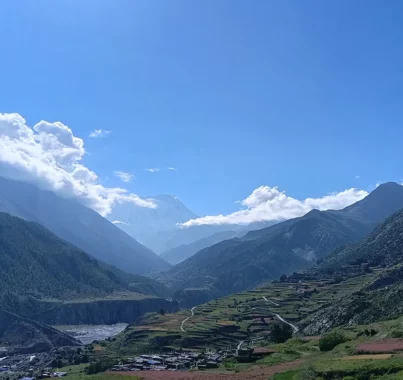
Spring is one of the best times of year to visit the Everest region, even though it might get a little congested. Base camp is crowded with tents during this time of year, and many other Everest climbers may be encountered. At lower levels, one can observe a vast array of flower species in addition to the breathtakingly clear blue sky.
Sunny days can reach up to 25 degrees Celsius, but the average springtime temperature is 17 degrees. The lowest temperature in areas higher than 4,000 meters is -15 degrees Celsius in the morning and evening.
Traveling at this time of year is not really suggested because it rains below 3500 meters. Even though it can be dry at times, very few people go during this time of year because rainfall only happens sporadically in areas higher than 4000 meters. Nonetheless, trekking during the monsoon season has advantages. Not only is it the best time of year to avoid crowds, but there are also many chances to see beautiful waterfalls due to the heavy rains.
At locations over 4000 meters, the monsoon season’s highest temperature averages 25 degrees Celsius on bright days, with lows of -15 degrees Celsius at night and in the morning. The typical temperature is about a comfortable 18 degrees Celsius.
In the Everest region, autumn is one of the nicest seasons to trek, but it is also one of the busiest, much like spring. Even while it is not as beautiful as flowers, you can see the clear blue sky, which makes for amazing views from almost every direction.
For regions above 4000 meters in elevation, the fall temperature averages 15 degrees Celsius, with bright days reaching a maximum of 20 degrees and nights falling as low as -10 degrees.
Trekkers should always prepare appropriately and pack clothes for both colder and warmer temperatures, regardless of the season. It is usually advisable to layer and wear pants that can be worn as shorts.
In order to prepare for the wide range of temperatures and meteorological conditions that can occur in the Everest region, travelers should consult their travel agency for a comprehensive list of what to pack. This will guarantee that the trip will be fun regardless of the weather and that all potential outcomes will be considered in advance.