




Trip booking for 2025 and 2026 is open, you can book any trip from our website.


Trekkers frequently stop at Lobuche on their way to Everest Base Camp. Explore the surrounding alpine scenery, lodging alternatives, and breathtaking vistas.
One of Nepal’s most recognizable and well-known trekking routes is the Everest Base Camp Trek (EBC), which has a lengthy schedule with numerous stops. One such stop on the EBC route is Lobuche.
Lobuche is a high-altitude town situated at an elevation of roughly 4,910 meters (16,109 feet) in the center of Nepal’s Khumbu area.
The adjacent Lobuche Peak, a magnificent mountain that is well-liked by climbers and explorers, is named after this hamlet.
The breathtaking views of Pumori, Nuptse, and the surrounding towering giants are the main reason for this location’s fame. But Lobuche is much more than just a place for tired hikers to relax or a place to see the scenery.
Lobuche has a distinct attraction because of its captivating natural beauty and its importance as a place for travelers acclimating to the Himalayas.
We will therefore cover all of the information you require about Lobuche in this article, including its location, importance, facilities, and main sites that you may visit.
Let us start with a quick geography of Lobuche: this community is situated in the Khumbu region of the Nepalese Himalayas, inside the breathtaking Sagarmatha National Park.
Located north of Dingboche and south of Gorakshep, Lobuche is an essential stopover—or rather, a changeover point—for trekkers en route to Everest Base Camp or Kala Patthar. It is a crucial component of the Everest Base Camp Trek.
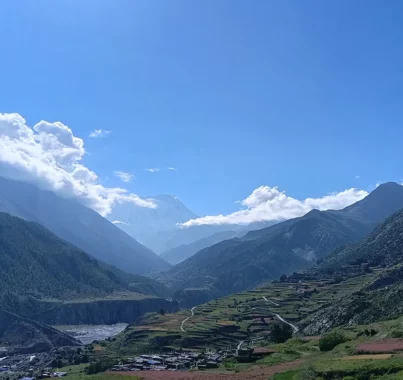
The shadows of the tall Himalayan peaks envelop Lobuche, which is 4,910 meters (16,109 feet) above sea level. In addition to being close to the Khumbu Glacier, this isolated settlement provides breathtaking views of the ice and untamed scenery.
Lobuche has a rich cultural heritage of its own, for those who are unaware. It has long been associated with the traditions and lifestyle of the Sherpa people, who were the earliest inhabitants of the Khumbu region.
Originally a little Sherpa town, it is now a well-liked destination for mountaineers and trekkers due to its location on the EBC trail.
Despite not being quite near to Lobuche, the Thukla Pass is close enough for many visitors to stop and think about the memorials there.
Taking a totally alternative path just to reach Lobuche is somewhat uncommon; instead, many travelers decide to stop there on their way to any of the Everest-related treks, such as the Everest Base Camp Trek.
Most hikes to Lobuche begin with a flight from Kathmandu to Lukla, the most dangerous and, at the same time, one of the most thrilling airports, leaving you speechless.
Following the flight, the hikers embarked on the Everest Base Camp path, which led them to Lobuche via Phakding, Namche Bazaar, Tengboche, and Dingboche.
Most hikers spend the night at Lobuche, which is frequently the seventh or eighth day of the Everest Base Camp Trek, in order to receive adequate sleep before moving on to Gorakshep.
Trekkers must cross the perilous Cho La Pass (5,420 m / 17,782 ft) on their way to Lobuche from Gokyo to Everest Base Camp.
Similarly, those trekking the Everest Three Passes counterclockwise will arrive at Lobuche after crossing the magnificent Kongma La Pass (5,535 m/18,159 ft).
Because of these roads, Lobuche is a significant and adventurous stop on the journey through the Khumbu region.
While visiting Lobuche, you will be treated to a number of highlights despite the village’s secluded location deep within the Everest Base Camp trail.
The breathtaking peak Lobuche is situated in the Everest region. Lobuche has two notable peaks are well-known: Lobuche
Lobuche West (6,145 m / 20,161 ft) and East (6,119 m / 20,075 ft).
Climbers with rudimentary mountaineering ability frequently visit Lobuche East, a trekking peak.
Because it provides an exhilarating climbing experience and significant acclimatization effects, it is frequently paired with the Everest Base Camp Trek.
Taking in the stunning views from Lobuche is one of the nicest things you can do while you are there. This is something you should be really excited about.
Lobuche might be considered one of the Himalayan vantage points because of the breathtaking views of the glaciers and snow-covered Himalayas that are available from this location.
Trekkers can appreciate the breathtaking view of rocky summits such as Pumori, Nuptse, Ama Dablam, Lobuche East and West, and other magnificent peaks from this location.
Though not precisely in Lobuche, the picturesque Thukla Pass is only a short stroll away from this high-altitude community. And you might have a lifelong memory of this incident.
Memorials to the climbers who died on the Everest, primarily while attempting to ascend Mt. Everest, may be seen in the treacherous Thukla Pass, which rises to 4,830 meters.
These sobering monuments serve as a reminder to hikers of the majesty and inherent dangers of the mountain, as well as the force of nature, which further inspires reverence, introspection, and thankfulness. Therefore, if you have time while in Lobuche, be sure to stop by here.
You can also take a detour to the Kongma La Pass, which is a part of the more complex and difficult Everest Three Passes Trek, if you are an adventurer with plenty of free time.
Kongma La Pass, the highest pass in the Everest region, is 5,545 meters high. Climbing this pass is as difficult as it sounds, as you might expect.
You will be rewarded with breathtaking views of Mount Everest, Nuptse, Lhotse, and numerous other peaks, though, making the journey also quite rewarding. A few of the numerous glacial lakes that encircle the route are open for exploration.
The Khumbu Glacier, a famous and enormous river of melted ice from Mount Everest that flows down from the Everest region, is quite close to Lobuche.
Because Lobuche is so close, hikers can enjoy pristine views of the glacier scenery and receive a close-up look at the Khumbu Glacier’s immense size and splendor.
The glacial moraines, crevasses, and frozen formations are so mesmerizing and bizarre that you will be in awe when you see them. The glacier’s ever-changing environment further heightens its allure.
An unearthly mood is created by the sharp contrast between the rocky paths and surrounding peaks that you would have encountered during the walk and the freezing crevasses of the Khumbu glacier.
Being at a place where there is absolutely no light pollution is one of the best benefits of being in a far-flung and unreachable place like Lobuche.
Lobuche is the ideal location for stargazing because of the thin air and high elevation, which provide a magnificent view of the night sky.
You can see the Milky Way galaxy spanning the sky and the dazzling stars, especially on clear evenings. Additionally, this might be a fantastic spot for astrophotography.
Lobuche is an excellent place for photographers to capture the ethereal grandeur of the snow-covered Himalayan hills that sweep throughout the area.
As you witness the many cultural groups engaging in their customs, rituals, and even day-to-day activities, you will be able to capture the very essence of Himalayan life in such a distant region.
Lobuche provides a breathtaking and unique opportunity to picture celestial wonders surrounded by the Himalayan peaks, making it an excellent option for astrophotography as well.
Accommodations and Facilities at Lobuche
Lobuche offers about seven guesthouses for lodging, the majority of which include basic lodge and teahouse facilities.
Due to its remote location and limited access, you should not expect luxurious stays, but these accommodations do provide hikers with the essentials for rest and renewal.
The basic bedding in the teahouses will include a mattress and extra blankets to keep you warm and comfortable through the night. You might even have to select a homestay if teahouses are completely booked.
Most of these rooms will be dorm-style or twin-sharing. They will also use the same restrooms. Private restrooms are few because of the location’s remoteness.
Furthermore, you will find that prices in Lobuche are rather higher than in other locations along the route. This is a result of the limited number of resources available.
All of the trekkers will gather in the communal dining area of the teahouses in Lobuche to share their trekking experiences over a hot lunch.
The menu is extensive and includes dishes like the traditional Dal bhat tarkari, momo, thukpa, noodles, soup, and other foods that will keep you warm and give you energy for the upcoming hike.
Coffee and baked foods are also available in many teahouses and lodges, which adds a cozy touch at this high elevation.
The majority of teahouses offer supplementary conveniences like Wi-fi and charging stations, but they are usually more expensive. However, since numerous hikers would be utilizing the same network, the Wi-fi connection’s dependability is in doubt.
Given that Lobuche is situated deep within the Everest Base Camp trekking route, the ideal time to visit is the same as the ideal time to complete the Everest Base Camp Trek.
In summary, the best time to visit Lobuche is during the busiest time of year, which is either spring (March to May) or fall (September to November).
You may enjoy unhindered views of the surrounding landscape and the majestic Himalayas, one of the highlights of the Everest Base Camp Trek, when trekking during these seasons because of the clear weather.
But around this time of year, the trail will undoubtedly be congested. Additionally, there is a potential that the teahouse in Lobuche will be filled due to its limited supply, particularly if you do not make reservations well in advance.
Extreme weather conditions can make the off-season—winter (December to February) and monsoon (June to August)—extremely difficult.
Consequently, it is best to avoid going to Lobuche during these off-seasons. If you do, though, be sure to have done all the necessary preparation. The absence of crowds on the trail is one benefit of trekking in the off-season.
You have probably come to the conclusion by now that Lobuche is not your typical Everest Base Camp Trek destination. Instead, it is a crucial halt that fulfills several functions and is a crucial component of a successful trek to Everest Base Camp.
Lobuche serves mostly as a place for trekkers on the EBC to acclimate. Even though Namche Bazaar and Dingboche have previously provided acclimatization, staying at Lobuche adds an extra degree of security.
The risk of altitude sickness rises in the Khumbu region because to the thin air. Trekkers can adjust to the thinner air by staying in Lobuche before moving on to Gorakshep and EBC, which are considerably higher.
In addition, Lobuche serves as a stopover to get ready for the last stages of the difficult Everest Base Camp Trek. It serves as a gateway to important locations as well.
Lobuche also serves as a place where mountaineers can get support. In order to plan excursions, hire guides, and acclimate, Lobuche is a base for individuals who wish to climb Lobuche East and West or even Mount Everest.
To top it all off, Lobuche represents the spiritual spirit of the Khumbu. Buddhist chants resonating in the distance and vibrant prayer flags flapping in the wind give the experience of trekking to the Everest Base Camp a deeper cultural dimension.