




Trip booking for 2025 and 2026 is open, you can book any trip from our website.



254 reviews in Tripadvisor


Duration
15 Days
Difficulty
Moderate
Group Size
2-10 People
Max Altitude
5,416m. / 17,769ft.
Best Season
Autumn & Spring
Activity
Trekking/Drive
Meals
All Inclusive
Accommodation
Guest House & Hotel
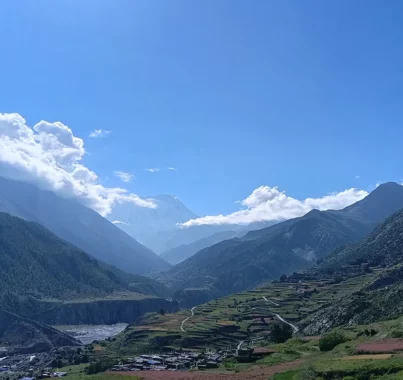
Nepal is known around the world for its spectacular trekking routes. Among them, the Annapurna Circuit trek route is ranked as the most acclaimed hiking destination after the EBC trek. Regarded as the most picturesque hiking trail in the mountains, the Annapurna circuit trek will undeniably bring mountaineering enthusiasts truly unforgettable experiences. In fact, it will be an opportunity for those who love long-distance trekking to be in the land of some of the highest and tallest peaks in the world and spend many days living in the nature of the Himalayas.
The 15 days Annapurna Circuit Trek journey will not be easy but once you complete this circular route, the long-lasting impression of the greatest Himalayas will etch in your memory for life. You will take the route in the heart of Langtang range, Pisang (6091 m), Lamjung (6983 m), Tilicho (7134 m), Annapurna I (8091 m), II (7937 m), III (7555 m), IV (7525 m), South (7219 m), Gangapurna (7455 m), Khatung kang (6484 m), Hiunchuli (6441 m), Gundang (5312 m), Manaslu (8163 m), Sangang, Fishtail (6993 m), and Nilgiri Peaks.
However, the Annapurna circuit trek is more than just the stunning Himalayas. It will also give you the thrill of conquering the Thorong La Pass, the highest in the world at 5,416 m. Additionally, you will also get the incredible chance to journey to 3210 m high Poon Hill, the best lookout point for the mountains, and an opportunity to regenerate at the healing natural hot waters of Tatopani. These remarkable highlights of our Annapurna circuit trek itinerary are just a glimpse of the remarkable adventure that lies ahead.
Your Annapurna circuit trek itinerary starts from Kathmandu with a journey towards Lamjung Valley. The progressive days will take you further into the Manang Valley concluding with a one-day stop at the Manang Village itself. During this journey, you will have a cultural discovery as you stay, interact, and learn about the Magar and Gurung ethnic groups. Now the natural scenery changes from fields, villages, and bright red rhododendron forests to arid glacier Valleys.
Once you cross the Pass of the Thorong La, our 15 days Annapurna Circuit Trek will journey you down towards the spiritually reflecting complex of Muktinath. From here, glancing at the raw beauty of the Lower Mustang, you will travel down to Tatopani and proceed towards the Gurung Kingdom of Ghorepani and Poon Hill. Once you have contemplated the magical light of the sunrise from this Viewpoint, you will bring the end to our Annapurna circuit trek and travel back to Kathmandu through Pokhara.
The experience of the Annapurna Circuit trek does not require great physical strength and there are comfortable lodges and rest stops. Therefore, this experience will be an exceptional choice for those who are in search of a fresh challenge. Welcome to a completely exceptional way to experience Annapurna!

Namaste! Nepal is ready to welcome you in its enchanting Himalayan landscape. One of our Everest Summit Treks team members will meet you at the exit from the TIA and after assistance with your bags, he will drive you through the busy capital to your appointed hotel.
Please take some moment to recover after a long international flight. Once all the hikers of our Annapurna Circuit Trek are in a hotel, our guide will come and meet each and every one. Then he will define you the details of our Annapurna circuit trek itinerary.
You will have the evening free to walk along the Kathmandu street, delve into the tasty cuisine and you can even see the night illumination of the Boudhanath stupa, if desired.


We will board a local bus early in the morning because a full-day journey awaits us today. Passing through the hustling Kalanki and Thankot, we will travel along the asphalt road of the Prithvi Highway towards Trishuli. Glancing at the rolling spectacle of Langtang, Lamjung, and Annapurna, we will then pass by the small town of Dumre. From here, our travel will follow the bank of the raging currents of the Marshyangdi River.
Past the river and green hills, we will soon reach Besi Sahar where we will take a lunch break and stretch our limbs. Then, we will change to the local jeep and start to travel on the dirt road which will be pretty comfortable till Khudi. Now, the road becomes bumpy, rough, and uphill as we travel onward towards Bhulbhule (840 m), Nagadi (930 m), Dobhantar, Ghermu, and Bahun Danda before finally reaching Syange of the Lamjung Valley from where we will begin to walk from tomorrow.
As for now, we will rest our limbs in the tea house, eat our first authentic village dinner, and enjoy the magical peaks.

Once we leave Jagat, we will be at the rugged terrain featuring tough climbs and narrow roads scattered with rocks and gravel. Navigating this trail, we will soon reach Jagat (1290 m) where we can see the huge frame of Manaslu and Annapurna.
For the next two hours, we will be facing some strenuous uphill sections until we reach Chamje (1430 m). The path will get even rockier and narrower as we ascend steeply to Tal (1700 m). Now, we are officially at Manang Valley from Lamjung where we can see the typical Tibetan-styled homes along with dusty and dry roads. We will pass by Karte before reaching Dharapani.
Now the real adventure of our Annapurna circuit trek begins as we will head towards Chame, the centre of Manang. The first section will be quite easy which later starts to become quite intense till we reach Bagarchhap Village (2160 m).
Annapurna II, and Manaslu though at a distance seem very grandiose from here. The onward journey will take us through two more lively settlements of Danakyu and Timang before we will find ourselves at Lata Marang (2400 m). We will now cross the final pine forest of Koto sitting by Phu Khola before we finally arrive at Chame. We are undoubtedly in the Himalayas now.
The gorgeous Himalayan terrain alongside the Marshyangdi River will lead us for two hours towards Bhratang Village. Here, we will cross a cute little bridge and walk up through the forest to find the almost 1500 m high rock slab of Paungdi Ridge at Dhukur Pokhari. From here, we will continue on to Lower Pisang (3200 m), and from here on, we will be in no hurry to walk as we are now over 3000 m height. We will push ourselves more for a short while along the steep section to reach Upper Pisang.
Pisang and Annapurna Peaks bestow their excellent view up here. Later, we can walk up to the Buddhist monastery above the town with 152 prayer wheels.
An early wake-up with the sunrise is worth it to see the sun painting the rock face of Annapurna and Pisang. We will have a quick breakfast then and will resume walking along the imposing mountain slopes towards Ghyaru Village (3670 m). Here we can see the three astounding peaks of the Annapurna range: II, III, and IV along with Tilicho, Gangapurna, and Lamjung lined up on the horizon.
We will then discover two more small villages of Ngawal (3657 m) and Bragha (3450 m) as we start to see the amazing Chulu range as well. We will then ascend into the ever-widening Manang Valley and spend the night in the town of Manang. This is the last major town we visit on the way up, so if we are still missing any equipment or clothing, we can get it here.
With the acclimatization hike today, we will prepare ourselves for the following days included in our Annapurna circuit trek itinerary. We can head up towards the 4130 m Bodzo Gompa or lookout point of Chongkor to see the snowy mountains under the first rays of the sun.
Then, we can proceed to the picturesque glacial lake Gangapurna, lying nearby. There is also Milarepa Cave which we can explore and a stupa where we can rest a while on the grass and eat our lunch. Then we will head back down and wander through the old town, a labyrinth of stone and wooden houses where the locals still live.
We will now continue our journey towards the High Pass of Thorong La. But first, we will ascend the sharp slope leading us towards the Tengi Manang (3650 m). We will be leaving the Marshyangdi Valley and walking higher and higher. Our climb will be more serious now so slowing our pace, we will eventually reach 3890 m Ghunsang Village. We head north and encounter yaks grazing freely along the grassy slope.
Finally, Yak Kharka is here not far above 4000 m where we can find few grasses and shrubs, rocks and mountains predominate here but we will have the lodge to relax in the evening.
After breakfast, we will set off towards Letdar which is the neighboring small village where we will arrive after an easy journey. The terrain now becomes a bit challenging so we will proceed even more slowly and reach the Thorong River.
After crossing the Thorong River, we will have to tackle the sharp climb for a moment till we make it to the arid land of Thorong Phedi where the stunning profiles of Khatungkan, Gundang, and Sagang can be seen splendidly.
A serious test of our strength today as we have reached the zenith of our 15 days Annapurna Circuit Trek. After an early morning, we will start to climb the trail towards the High Camp of the Pass. The path will wind steeply in endless bends as we arrive at the 4800 m High Camp of the Pass. Now the most difficult section begins as the last 500 m stretch to the pass still remains ahead.
The climb is not that sharp but there are endless hills to overcome. Soon, the colorful prayer flags appear and we have reached the pass. Dhaulagiri, Hiunchuli, Manaslu, Lamjung Himal, Annapurna I, Fishtail, and Nilgiri shine extraordinarily and seem profoundly beautiful. We will now set off towards Muktinath from the other side of the Pass. Crossing Rani Pauwa, Ekle Bhatti, and Khinga, Muktinath will soon be arrived which is the important religious center for both Hindus and Buddhists, with a lot of cultural and spiritual value.
Early morning, we will visit the huge temple complex of Muktinath and run under the 108 cleansing springs. We will also see the ever-burning eternal flame in the temple and then set for the journey towards Tatopani. We will get on the local bus and descend towards the settlement of Kagbeni of the lower Mustang Valley and the gateway to the neighboring kingdom of Upper Mustang.
The road from Kagbeni will continue on to rise towards the village of Dagarzong and then descend towards Jomsom which also happens to have a small airstrip so if you like, you also engage in a short flight to Pokhara from here. We will however continue on along towards Marpha and drive through various tiny Thakali, Gurung, and Magar settlements of Dhonga, Kobang, Larjung, Kokhethanti, Dhampu, Kalopani, Ghasa, Dana before finally arriving at Tatopani.
After taking or lodging, we can proceed to take a dip in the almost 40 to 40-degree heated natural hot water of the spring in Tatopani.
From Tatopani, we will head south and cross a hanging bridge over the Kali Gandaki River. We will turn right and move on to Birauta and Ghara Villages.
A steep climb will lead us through Ghopte Kharka to Shikha Village where the Dhaulagir and Nilgiri can be seen exclusively. After some time with these beauties, we will walk through Phalante and Chitre to finally arrive at Ghorepani.
A 4:30 am alarm clock will wake us up and then we will set off for an hour-long climb to the Lookout Point of Poon Hill. We will greet the sunrise here over Dhaulagiri, Annapurna South, I, II, III, Machhapuchhare, Nilgiri, Gangapurna, Tukuche, and several others. After spending an hour admiring the view, we will return to Ghorepani for breakfast and walk down behind the Village of Ulleri where we will struggle with the 3300 big stone steps which will lead us to Tikhedhunga.
From here, the almost asphalted easy path will lead us down through Birethanti to Nayapul where we will take a jeep to drive for around one hour to reach Pokhara. If we have enough energy left, we can visit downtown Pokhara and enjoy its bustling metropolitan character.
We are set for the early morning departure to Kathmandu on a tourist bus. The rolling green hills, the enraging Tirshuli waters, and the familiar traffic of Kalanki will take us inside the capital.
After a few moments of rejuvenation, you can then head on to explore the Swayambunath or Durbar Square
After you enjoy your last breakfast in Kathmandu, it’s time to move on to TIA for your home departure.


For our Annapurna circuit trek, your standard accommodation in Kathmandu will be in a twin-sharing room of a reputable three-star hotel such as Hotel Manang or Hotel Thamel Park at a rate of just USD 45 per night. However, if you like to upscale your experience during your Kathmandu stay, then we also facilitate an upgrade to a four-star hotel for an additional cost.
You will have the choice between Hotel Shankar, Hotel Ramada, Hotel Yatri Suites, or similar. These hotels are well-known in the city for their excellent amenities that include 24-hour room service, spa, restaurant, fitness center, and large rooms with flat-screen TV and minibar. Here, you will also have access to meeting rooms, a lounge area, a garden, a swimming pool, and a bar. They maintain not only exceptional service but also cleanliness throughout.
So if you are intrigued with this option, then please tell us ahead and we will finalize your arrangements before you are in Kathmandu.
Your Annapurna circuit trek commences with a long local bus ride from Kathmandu to Besisahar where you will get in a local shared jeep to travel to Syange. In between the trips, when you travel from Muktinath to Tatopani, you will again rely on the local bus service. And, when during you return, you will get on a tourist bus to travel to Kathmandu from Pokhara.
The local bus services in Nepal are generally satisfactory, however, the roads are not fully asphalted, which means your journey will often take place along uneven dirt tracks that can lead to extreme exhaustion. You will make stops at various points along the way but you will have to stick to the bus schedule. If you desire a more comfortable travel experience, we provide you with an upgrade option with private jeep transfers for all ground transportation throughout your trip.
This upgrade allows you the use of a private jeep for travel from Kathmandu to Syange, from Muktinath to Tatopani, and from Kathmandu to Pokhara. You may also choose to partially use the private jeep service for particular segments of your journey, such as from Kathmandu to Syange or from Pokhara to Kathmandu.
Please note that selecting this service can result in an increase in the overall cost of the trip.
Our Annapurna circuit trek itinerary includes a drive from Muktinath to Tatopani through Jomsom, and then hiking up to Poon Hill. If you are in a hurry, then you can either trek or drive from Muktinath to Jomsom instead. Jomsom is a pretty developed small town with a small airstrip that operates the local flights to Pokhara. If you like, we can set up a direct flight from Jomsom to Pokhara so you will have more time to enjoy and relax in this queen city.
The most comfortable and favorable time to conquer the 15 days Annapurna Circuit Trek is from the mid-March days to the latter days of May (Spring), and from the mid-September days to the latter days of November (Autumn/Fall).
During April and May, the Annapurna mountains enter the season of melting snow, the season of blooming rhododendrons, purple phoenix flowers, and mustard flowers that dye the whole space yellow. However, at this time in Annapurna, you should also be prepared for the sudden transition in temperatures which can be very hot but then suddenly become cold.
On the other hand, during autumn, the weather is cool, and the scenery is romantic with burnt grass and yellow leaves covering the high mountains. You should avoid going for the Annapurna Circuit trek trail during the rainy time between June through August and the cold winter time between December through February. The river-flooded trails in summer and the snow-piled trail to the Pass in winter will hinder your journey.
Our 15 days Annapurna Circuit Trek is a mountain hiking trail that is designed for people aged 15 and above who enjoy walking in nature for longer days. The history of high-altitude travel or trekking is not needed nor is any technical usage of gear. Thus, the Annapurna circuit trek is technically easy however it is essential to understand that the journey is not going to be like walking in the park or jungle.
In terms of difficulty, the trek falls within the moderate or upper intermediate category of hiking journeys in Nepal. However, it is available to even those who are new to mountain hiking, provided they have adequate fitness and health. Our team at Everest Summit Treks has carefully planned this route to ensure that participants of all ages and experience levels can manage it. The highest altitude that the participants will reach is 5416 m of Thorong La Pass where no longer or overnight stay has been planned.
It is still important to understand that for six consecutive nights, participants will be sleeping at elevations exceeding 3,000 meters, which may lead to potential health issues related to hypoxia and the challenges of high-altitude living. The trek also involves a total of nine days, during which participants will hike with backpacks, typically for 4 to 7 hours each day, most of the time uphill and downhill.
One day will involve a significant elevation gain, but the use of ropes, crampons, or chains will not be necessary. But there are certain contraindications that may prohibit participants from taking part in this trip which include issues related to the musculoskeletal, circulatory, or respiratory systems, and a general aversion to hiking.
Our 15 days Annapurna Circuit Trek is more perfect for undertaking by experienced hikers as they will be more familiar with the risk of some serious altitude gains. The Nepal mountain trails on the other hand are never relatively flat and they contain some steep slopes at some point. As for this trek particularly, there will be some seriously steep climbs and descents that can even go up to 1000 to 1600 m. Most days, you will walk up to 4 to 6 hours and we cannot forget about the mighty Pass as well.
However, it doesn’t mean the newcomers cannot access this trip; they definitely can if they are ready to face the challenges, altitude, and weather, and if they are in their prime health. There will be a lot of sudden temperature changes which is the typical nature of the mountains but it is absolutely a must-do for a Himalayan lover. Plus, the Annapurna areas that we will be passing through are largely inhabited with access to roads, and even the dirt tracks are well-maintained. In addition, there are multiple lodge facilities en route and the elevation will also be lower than that of the Everest Base Camp trek. So with the determination, right motivation, health well-being, and preparedness, you will definitely be able to do our Annapurna circuit trek.
When undertaking the 15 days Annapurna Circuit Trek, the altitude and the risk associated with it are the primary concern. Often, the high atmosphere in the areas above 3000 m is less in oxygen and pressure that we are used to at our home ground which thus results in altitude sickness also known as the Acute Mountain Sickness/AMS. Our bodies can well get used to the heights provided the enough time. Thus, our Annapurna circuit trek itinerary includes a driving journey to a relatively lower area followed by a gradual hike. We also have incorporated a rest day in Manang to get accustomed to the dry Manang air before tackling the massive height of the Thorong La Pass.
We will also proceed on our journey further taking our time when going up. Remember, if you rush up, you will face some altitude-related issues such as trouble sleeping, extreme tiredness, appetite loss, vomiting, nausea, and bad headaches. If any one of these conditions occurs, it is important that you halt your progress right away and stay at the same elevated area for a few days to help with acclimatization.
If you still feel the same, then medications like Diamox (acetazolamide) can help. N addition, you also focus on staying hydrated as dehydration can also trigger the AMS. You should aim for at least three liters of fluids a day, including hot broth, drinks, teas, and soups. Plus, also layer up to maintain your body temperature.
The Annapurna circuit trek is definitely tougher and demanding than its sister counterpart: the Annapurna Base Camp trek. There will be more days on higher grounds, more days of climbing and descending, and more days of walking. So for an indispensable experience of the Annapurna circuit trek, you need to prepare 1 month before the trip to improve your physical strength. If you are new to working out, then it is better to start preparing two months before.
You should also take it slow and make sure to give yourself enough time to recover between workouts. To boost your fitness and health for the adventure, more simple exercises such as swimming, cycling, and running will do the best. You should also focus on any cardio exercises that can get your heart pumping such as skipping. Also, do not forget to work on your calf muscles as they will be the ones doing most of the job when you are walking.
If you can, try stair climbing with a weighted backpack to build those legs up. You can also run up the hills to strengthen your calves. If you don’t have hills or stairs, you can focus on strength training for your calves. Bike rides, long runs, and long hikes along with mixing in different activities, can help you train well without overdoing it on any one muscle group.
According to our Annapurna Circuit trek itinerary, we will first walk around Annapurna and head to Thorong La Pass, then only, we will head to Poon Hill. If you prefer, you can head to Poon Hill first, then choose to walk around the Annapurna and overcome the Pass of Thorong La. Both routes give you plenty of time to get used to the high altitude. If you want to lessen the trek days of your journey, you can also let the Poon hill trek go.
On the other hand, if you want something a bit different from the usual tourist trails in Annapurna, then you can also undertake a different route through the distant settlements such as Ghalegaon, Bhujung, Ridge Camp, Joli Kharka, Thulo Tal, Phulu, Kori, Tasa Kharka, Sikles, and Ghawchok, finally finishing up in Pokhara. You will have a real taste of rural Nepal with the adventure of the camping nights. You can also choose to tackle another great pass known as Kang La (5320 m) slightly lower than the Thorong La.
This pass will lead you into the extraordinary Nar and Phu Valleys. For this, you can walk from Upper Pisang to Ngawal. Another beautiful option for the Annapurna circuit trek will be to merge the trek to the 4130 m Annapurna Base Camp itself.
You should also think about Lake Tilicho, which can be reached with a diverted route from Manang. Or, why not stay for a few more days in Manang or go on a walking journey to Lower Mustang from Jomsom to Marpha?
During the 15 days Annapurna Circuit Trek, you will have a two-night stay in a double room at a delightful three-star hotel in Kathmandu, followed by a night in a similar establishment in Pokhara where bed and breakfast await you each morning. Along your journey, you will be welcomed into charming tea houses of the overnight settlements where you will share moments, and meals with fellow adventurers.
The quality of the tea houses has seen a remarkable upliftment in recent years in Annapurna. In many villages, you will find hotels like tea houses where you can have private baths, hot showers, double or single rooms, WiFi, and electricity.
As for meals, we will present you with three meals a day at lunch, breakfast, and dinner throughout your trek. You must at least once eat Dal Vat and try Momo. As for other food items, you can also get noodle dishes, egg varieties, pizza, tuna, mutton, chicken, pasta, and many more.
On our Annapurna circuit trek, we have looked after your comprehensive transportation solutions. You will have a complimentary private transfer to and from TIA in Kathmandu. As your adventure commences, we have organized a comfortable local bus journey from Kathmandu to Besisahar, followed by a shared jeep ride from Besisahar to Syange. At Muktinath, a local bus will transport you to Tatopani. Likewise, a shared jeep will take you from Nayapul to Pokhara, where a tourist bus will complete your journey back to Kathmandu.
We must have two indispensable permits for the 15 days Annapurna Circuit Trek which are the Trekkers’ Information Management System (TIMS) and the Annapurna Conservation Area Project (ACAP) Permits. The TIMS, at a fee of NPR 2000 per trekker, will help the concerned authorities to monitor the progress of each trekker in the region while the ACAP at NPR 3000 will allow the trekker to walk uninterruptedly inside the restricted region. We will manage the permit procedure and the fees for you.
Please remember that travel insurance is a non-negotiable requirement for our Annapurna Circuit trek for the procurement of obligatory permits. It is not only a formality but also a very important shield that will protect you from all sorts of risks you may have during the trip. Illness, lost bags, sudden changes in the plans, accidents, severe AMS, and loss on the trail are some of the unforeseen events of the treks. In such cases, your travel insurance will look after your financial safety; it will cover the cost of your search and rescue.
It will also compensate you in case of any damage or loss to your belongings, or in case of any delays or postponement of the trip requiring you to stay a few extra days in Nepal. Likewise, your travel insurance will also look after your medical bills in need of hospitalization. Please recheck that your policy includes the services for up to the height of 5500 m for this trek.
Those who have enough motivation to take this type of adventure, who have 15 days of free time, who can spend a few days in the high mountains, and who can walk several km a day with a backpack in the mountains.
Absolutely not! There are no dangerous precipices, the trail does not go along any exposed ridges, there will be no usage of any gear, only your foot, and in case of health problems, quick transportation to Pokhara is also possible.
It will be around 160 km in total.
The minimum value should be NPR 30,000 which will allow you to pay for missing meals in Pokhara and Kathmandu and purchase drinks during your stay inside the mountains.
The circuit trek will take you on the route that spans all around Annapurna Mountain while the ABC trek will lead you straight to the base camp of Annapurna I.
Yes, NTC and NCELl can be used for mobile communication which supports all types of devices and lodges in the area and also provides paid Wi-Fi and charging facilities for your use.
