




Trip booking for 2025 and 2026 is open, you can book any trip from our website.



254 reviews in Tripadvisor


Duration
7 Days
Difficulty
Moderate
Group Size
1-15 People
Max Altitude
5,416m. / 17,769ft.
Best Season
Spring & Autumn
Activity
Treking
Meals
Breakfast, Lunch & Dinner
Accommodation
Teahouse & Hotel
The Annapurna Circuit is a photographer’s paradise. You may see some of Nepal’s most isolated regions and get a taste of the typical mountain life on this trek. Trekking the Annapurna Circuit is thrilling, daring, and exciting.
There is also an amazing trekking track. There are many stunning waterfalls and suspension bridges. Additionally, the murmur of the glacial river below soothes you the entire way.
Every year, hundreds of hikers gather their equipment and set out on the Annapurna circuit journey. The snow-covered mountains appear majestic and lofty. This walk may be finished in two weeks. However, you may always alter the schedule to fit your needs.
The actual trekking begins at Besisahar (750m) or Bhulbhule (840m), with our tour beginning in Kathmandu (13250m). We will also spend the night in Ngawal (3680), Timang (2350m), Dhikur Pokhari (3240m), and Chamje (1385m). Finally, on the sixth day of our adventure, we will arrive in Manang (3520m).
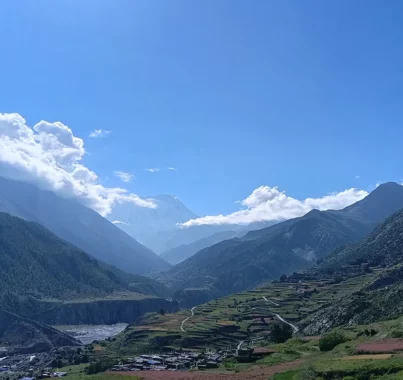
Manang village is stunning. There are mountains and hills all around it. After a suitable day of acclimatization at Manang, we will go to Ledar, which is 4,200 meters above sea level. Beautiful scenery abounds when trekking from Ledar to Phedi (4660m) or High Camp (4880m). Although the rocky walk may appear exhausting, the experience is quite amazing.
On the sixth day, we cross Thorong La Pass (5416m) and arrive at Muktinath (3710m). Following that, we will remain in Tatopani (1200m) and Jomsom (2700m) before arriving in Pokhara (820m). When we arrive in Kathmandu, our amazing voyage comes to an end.

We are traveling via Besisahar this morning from Kathmandu to Chame. As we cross rivers and go through terraced fields, you will catch a view of the Annapurna and Manaslu, two snow-capped mountains. Through the villages of Sange, Bhulbhule, Nagdi, Chamche, Tal, Dharapani, Bagarchhap, Dankya, Timang, Thanchowk, and Chame, we will go by jeep from Besisahar to Chame for around three to four hours


Our actual route steps begin in Chame, where we first traverse a narrow and steep valley to see the Paungda Danda Rock face, a curving rock face that rises 1500 meters above the river. Along with Paungda Danda Rock, you will also enjoy clear views of Annapurna II in the south and Pisang Peak in the northeast. After that, we descend to the floor of the Manang Valley to arrive in Pisang, our goal for the day.
We continue traveling through Geru and the upper Pisang trails today. Because it offers a breathtaking view of the northern faces of Tilicho, Pisang Peak, Gangapurna, and Annapurna II, III, and IV, we chose this trek. As we climb, you will notice that the air is cold, dry, and harsh. This trail will take you past several Tibetan-style communities where you may learn about Buddhist culture before you reach Manang. The largest monastery in Manang, Barge Monastery, will be our quick stop
Our four day of the path will be difficult because we will be climbing more than 500 meters. First, we travel to Tanki Manang, which is located in upper Manang Village. Stone-built homes with flat roofs can be seen in Tanki Manang, and as you go on, you will see that there are no other communities in the area.It is a place of loneliness. At last, you will cross the little settlement of Gunsang and reach Yak Kharka, a serene meadow. It was difficult to get to Yak Kharka, but it is easy to get to Ledar from there. We are going to Ledar for the night
Our trek today will be short, lasting three to four hours, as it helps with acclimatization. After leaving Ledar, we continue hiking until we reach Phedi (4,510m), where we cross the Jorsang River (4450m). In Nepali, the term “phedi” describes the foot of a hill. We make ourselves stay overnight at Thorung High Camp, which is 4,925 meters (16,158 feet) above sea level
Our seventh day of the journey will be the most difficult since we will be traversing Thorong La Pass, the highest point of the trek and one of the highest passes in the world. The vistas from the pass are well worth the early wake-up time of 4 am, but we must push ourselves against the frigid air and difficult high-altitude routes.
The Annapurna massifs may be seen when you turn around from the Thorong La Pass, which offers a view of the magnificent Himalayan peaks that stretch all the way to Tibet. We descend to Muktinath after taking in the sights from Thorong La Pass.
The steep slope will take three to four hours to complete. Muktinath is revered by both Buddhists and Hindus; the Buddhists call him Chumig Gyatsa, which means “Hundred Waters” in Tibetan. It is really cold in Kali Gandaki, the water that flows from 108 water shoots at the Muktinath Temple. You can also see the eternal flame that has been burning there for about two thousand years
We will visit Muktinath Temple, a highly revered Buddhist and Hindu temple, prior to traveling to Pokhara. Before continuing on to Jomson, where we will drive back to Pokhara, where our trip comes to a conclusion, we will also stop by the Jwala Mai Sanctuary


On your arrival, we will provide a complimentary private vehicle pickup from the airport and drop you off at your hotel; on your departure, we will do the same. Our agent will be at the Tribhuvan International Airport with a booklet with your name. After giving you a Khada or Marigold garland as a welcome gift, they will drive you to your accommodation. To use this free service, you must enter your flight information. We offer this service to help you feel less alone when you move to a new nation.
You will arrive in Kathmandu at least one day before the trek departure date, which is before 3 pm. On the day of the trek departure, your trip leader will pick you up from the hotel and take you to the bus station, where you can catch a bus to Besisahar. Local transportation from Kathmandu to Besisahar, as well as from Besisahar to Chame, Muktinath (via Jomsom), and Tatopani, is included in the package. You can reserve a private jeep for extra money.
The 7-day Annapurna Circuit Trek consists of one night at the nicest hotel in Pokhara and lodge-to-lodge stays throughout the trekking areas. We choose the greatest lodging options anywhere.
In Besisahar, Chame, Pisang, Muktinath, and Tatopani, you will spend five nights in twin-sharing rooms with private connected bathrooms. At Manang, Ledar, and Thorong High Camp, you will also stay for three nights in regular twin-sharing accommodations. A hotel room with a TV, 24-hour power, hot water, laundry facilities, and an attached bathroom will be yours for one night in Kathmandu and Pokhara.
Although they are not included in the program, one nights in Kathmandu before and after the trek might be necessary. There are many different hotels in Kathmandu to fit your preferences and price range.
You must consume adequate amounts of protein, carbs, and other nutrients because this hike takes you to high altitudes close to the highest peaks in the world. You may not have all the options you have in large cities, but we will give you wholesome cuisine.
In the trek area, we will provide ten breakfasts, nine lunches, and eight evenings. All meals are provided full-board. Western, Asian, and traditional cuisines are available as menu items. But the menu will get shorter as we move higher.
We strongly recommend eating fresh vegetables and drinking hot lemon, ginger tea, green tea, lemon tea, and garlic soup (essential) at high heights. We also recommend that you try some of the most popular Nepali foods, such as chow mein (noodles), dal (lentil), momo (dumplings), tarkari (curry), and bhat (rice).
Although trekking regions provide a wide variety of non-vegetarian meals, we do not recommend them because the meat may not be hygienic. We also recommend avoiding hot chocolate, dairy products, alcohol, and foods that contain caffeine.
Except for standard meals (breakfast, lunch, and dinner with seasonal fruits), the package does not include any personal expenses for alcoholic beverages, hot beverages (tea, coffee, etc.), or cold beverages at tea houses, hotels, or cafés. Similarly, this package does not cover lunch or dinner in Pokhara.
We provide one porter for every two hikers, and a porter is only permitted to carry a total of 18 kilograms of luggage. That means that each trekker can only bring 9 kilos of luggage. Additionally, we anticipate that you will have a small backpack for your belongings. Please only bring the necessities. Your extra luggage can be left at our office store or at your hotel. For the duration of their walk, we provide our trekkers a complimentary luggage storage service.
You will travel, climb, take in the sights, take pictures, and explore the nearby communities every day. Our knowledgeable Sherpa guide will provide information and historical details about the locations you will be traveling during the expedition or trek. The majority of your luggage will be carried by the porters. For your belongings, you might also need to bring a small backpack.
A hot cup of tea or coffee in the morning kicks off the day. Depending on the length and type of the walk, you will start your day’s walk between 7 and 8 am after breakfast. You will eat lunch around midday on the way to the next location after three to four hours of walking. After an hour of recuperation, you will resume your journey.
In general, the afternoon stroll lasts between two and three hours.
You can explore the region and eat the additional meal as soon as you get to the tea shop, tent, or overnight lodging.
It is roughly 6:30 p.m. when dinner is served. Before you go to sleep, you can have nice conversations. Your trip leader or guide will describe the plan of action for the next day. After this briefing, you can play games like Monopoly and cards on board or watch videos about mountaineering. Most of our guests also choose to learn common Nepali words. If you like to read, you are welcome to bring one or two books.
Tipping is a means to express thanks and is accepted and respected in Nepali society. Trekkers are free to tip, and it should be determined by the length, cost, and quality of the services received. Tipping is suggested both individually and as a group at the end of the tour.
On the last day of your trip, you will travel from Tatopani to Pokhara by local transportation. On the way, you will leave the settlement of Beni Bazaar. Your adventure comes to an end at Pokhara. In Kathmandu, we will organize a farewell dinner.
The short trek around the Annapurna Circuit is a modest challenge. Because of the lengthy trekking days, the steep ascents and descents, and the high elevations involved, it calls for a solid level of physical fitness. Trekkers who have hiked before and who plan beforehand, however, can handle the journey without facing many difficulties. Trekkers can adapt to the conditions thanks to the various terrain and the altitude acclimation plan, but be ready for physically taxing days, particularly over 3,500 meters.
Yes, we do provide private short treks around the Annapurna Circuit.
With private treks, you can alter itineraries, select lodging based on your tastes, and request special dietary needs.
The Nepal Tourism Board office in Kathmandu or Pokhara is where you may get the ACAP and TIMS permits. Along with completing some paperwork, you will need to provide passport-sized pictures. However, we will set up the permissions for you if you reserve your hike with us.
Yes! The required permissions (ACAP and TIMS) are included in our trek packages. The paperwork will not be a concern for you. Before your walk starts, our staff will make all the necessary arrangements.
Yes, it is a good idea to pack personal prescriptions, such as pain relievers, altitude sickness tablets, a first aid kit, and any prescription drugs you take on a daily basis.
