




Trip booking for 2025 and 2026 is open, you can book any trip from our website.



254 reviews in Tripadvisor


Duration
12 Days
Difficulty
Easy
Group Size
1-15 People
Max Altitude
5,416m. / 17,769ft.
Best Season
Spring & Autumn
Activity
Trekking
Meals
Breakfast, Lunch & Dinner
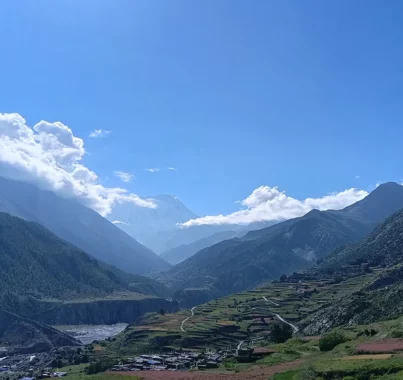
The Annapurna Circuit 12-day Trek you can travel to the isolated trans-Himalayan region, which is home to several magnificent snow peaks, including Annapurna, Gangapurna, Dhaulagiri, and Machhapuchhre. From Jomsom, you can take a plane to Pokhara along this portion of the Annapurna Circuit, which also goes by a number of monasteries, Gumbas, holy temples, high passes, natural hot springs, and unique ethnic settlements.

After breakfast, we will take a bus from Kathmandu to Bhulbhule in the west. The bus will go next to the Trishuli River along the Prithivi Highway till it reaches Dumre. From Dumre, you will go north past Besishahar to Bhulbhule, which is situated on the Marsyangdi River.
While riding, you can see terraced fields, local settlements, and the Ganesh and Manaslu mountains. It will take around eight hours to travel to the Gurung village of Bhulbhule, where you will spend the night.


Early in the morning, we depart Bhulbhule and travel to Jagat via the trails. Trekking along this pleasant road will take you through terraced fields, traditional towns, and lush forests. You will travel past Bahundanda and Ghermu from Bhulbhule to Jagat, a former trading post.
Crossing the Marsyangdi River from Jagat, the route climbs through a tropical forest before arriving at the Gurung settlement of Chamje. You will see the Annapurna ranges and a picturesque waterfall while trekking. Following Chamje, the Marsyangdi river will lead you once more along a winding road that ascends to a hill and leads to the settlement of Tal. Tal means lake in Nepali.
To get to Marsyangdi, however, you will have to climb to Karte Village, where the trail continues along the cliffside and descends again. You will then cross a suspension bridge and climb to Dharapani, where you will spend the day.
We leave Dharapani and follow the paths through the trees of pine, fir, oak, and maple. This region is comparatively level, and the Marsyangdi River leads to the Manang-Chame headquarters (2,670m). From Chame, you may take in the stunning views of Annapurna II, Annapurna IV, and Lamjung Himal. Along the way, we will make sure to stop by a little hot spring.
We follow a path that primarily travels through an open region from Chame to Pisang. After walking along the narrow valley, you will reach a massive rock called Paungda Danda Rock, which the locals consider as sacred. The rock itself is a breathtaking sight, rising 1,500 meters above the Marshyandi River. You will view Pisang Peak in the northeast and Annapurna II in the south as you continue your journey. The trail drops to the Manang Valley floor just before Pisang.
We start our ascent up the upper routes that pass Upper Pisang and Geru to reach Barge hamlet, which is famous for the Barge Monastery, the largest in Manang. Along the way, you will pass several Buddhist monasteries and shrines before reaching the popular resort of Manang. The trekking trails offer stunning views of Tilicho, Pisang Peak, Gangapurna, Annapurna II, III, and IV.
We have set aside this day for rest and proper acclimatization in order to avoid altitude sickness. But we will still remain active, traveling to nearby places and enjoying the scenery. Manang’s convenient position allows access to interesting places. The Gangapurna and Ice Lakes, the ancient Kangsar village, and Milarepa Cave—believed to be the Buddhist Guru Milarepa’s meditation site—are all visible. We will also take you to the Himalayan Rescue Association in Vraja hamlet to learn more about acute mountain sickness.
After taking a day off to rest and adjust, we climb toward Ledar. The large trees along the trail now give way to alpine grass and junipers. If you are lucky, you might spot some horses or yaks grazing on the meadows.Additionally, as you proceed along the trails, you will pass Gunsan, a small village distinguished by its flat mud roofs. You should be aware that Yak Kharka, a serene meadow, is close by when you cross a tiny river on a wooden bridge. Once you reach the Yak Kharka meadows, you will cross a medieval Mani wall to arrive to Ledar hamlet.
It is time to depart the Marsyangdi Valley and follow the Jharsang Khola towards Thorong High Camp. The high Himalayas, which contrast sharply with the verdant lowlands you traversed during the first several days of trekking, will greet you when you leave the pine and fir woods behind. While trekking, you may be fortunate enough to see snow leopards and blue sheep. Before attempting to cross the Thorong La High Pass, tourists can spend the night at Thorong High Camp, which is conveniently positioned.
Today will be the most challenging trekking day because it involves climbing the Thorong La High Pass, one of the highest passes in the world, and then descending to Muktinath. Despite the high altitude and chilly air, we will still be able to appreciate the vistas, and we will start the walk early in the morning to avoid the afternoon wind. From the pass’s summit, you can take in breath-taking views of the Annapurna, Gangapurna, and Khatungkang ranges. As you descend, you will be rewarded with breathtaking views of Dhaulagiri.
The descent continues till you reach the holy Hindu and Buddhist temple of Muktinath. The temple’s most well-known features are 108 water sprouts and an eternal flame that has burnt here for eons. In order to make the flight to Pokhara the next morning, we will drive from Muktinath to Jomsom for around two and a half hours.
We shall take an early morning flight to Pokhara from Jomsom on this particular day. You may take in breathtaking views of Annapurna Himal, Dhaulagiri, and Nilgiri throughout the 35-minute flight (23,166 feet and 26,795 feet, respectively). You are free to explore Nepal’s tourist capital, the stunning city of Pokhara.
The 12-day trek package for the Annapurna circuit ends today. After an early breakfast in Pokhara, you will travel to Kathmandu on a tourist bus. The bus will travel 220 kilometers before arriving in Kathmandu. You might choose to pay for your own flight from Pokhara to Kathmandu.


Our company representative will meet you upon your arrival in Nepal, display a sign with your name on it, give you a marigold garland or a Mala Khada, and then drive you to your accommodation. When the expedition departs, we will put you on a local bus to Bhulbhule.
After traveling to Dumre along the Prithivi Highway, the bus will head north to Besishar and then to Bhulbhule (845 m), where your trek will begin.
Ten nights will be spent at the highest lodges or teahouses in the hike area. You will stay in rooms with connected bathrooms at Jagat, Dharapani, Chame, Pisang, Manag (2 N), and Muktinath for seven of these ten nights.
In Bhulbhule, Yak Kharka, and Thorang Phedi, you will be accommodated in regular rooms. Every room is shared by two people. The majority of lodges offer hot showers, Wi-Fi for internet access, and power for charging electronics, though these extras may be charged.
We serve eleven breakfasts, nine dinners, and nine lunches in the trek areas. All meals are provided as full-board meals.Your menu offers Western, Asian, and traditional regional cuisine, but as you progress, the options get increasingly limited.
To keep you going during the hike, however, we make sure you eat nutritious meals. We suggest that you try some of the most popular Nepali foods, such as chowmein (noodles), dal (lentils), bhat (rice), momo (dumplings), and tarkari (curry).
We strongly recommend drinking plenty of water throughout the hike, including ginger, green, and lemon tea, hot lemon, garlic soup (which is mandatory), and fresh vegetables at higher elevations.
We do not recommend using non-vegetarian options because of hygienic concerns, even though they are available in the hiking areas. Similarly, avoid dairy items, alcoholic beverages, caffeinated beverages, and hot chocolate.
Porters are assigned to carry your bags, however you can only weigh up to 9 kg. Two hikers’ worth of luggage, weighing no more than 18 kg, can be carried by one porter. Therefore, we suggest that you pack your belongings in a duffel bag that can hold more than sixty liters and travel with a fellow hiker.
We advise you to only bring the necessities for the hike. We have a store where you can keep extra luggage. We also anticipate that you will have a small backpack with you for important documents, valuables, and frequently used items like a water bottle.
Your lead guide will continue to communicate with our colleagues in Kathmandu, giving them phone updates on your progress. For dependable communication, we advise you to purchase a local SIM card in Kathmandu. The signals might not be powerful enough at high heights, though.
You need a valid visa in order to enter Nepal. Fortunately, most visitors can get an on-arrival visa at Kathmandu’s International Airport. To obtain an on-arrival visa, you must have a passport with at least six months left on it, a passport-size photo, and an application fee. The application fee is based on how long you plan to remain. The current rate is USD 50 for a 30-day stay.
Travel insurance that covers emergency helicopter evacuation up to 5,500 meters and medical costs is mandatory. Please call your insurer to find out if helicopter evacuation up to 5,500 meters is covered by your policy.
Major trek-related expenses are covered by our program, but not all of them. Your stay in Kathmandu will cost money. Similar to this, you will also need to pay for Wi-Fi, meals in Pokhara, lodge fees, tips, and souvenirs. You will require approximately USD 15 per journey day, depending on your spending patterns.
While the experience changes by season, the walk may be done at any time of year. With clear skies, blooming rhododendrons along the trails, and mild temperatures (0–8 °C at high elevations), spring (March–May) is the best time of year to go trekking.
Because of the clear skies, pleasant weather, and cultural festivals, autumn (September to November) is another great time of year for trekking. With breathtaking views, high altitude temperatures can reach 20 °C during the day and 5 °C at night.
The summer months of June through August bring a lot of rain, which makes the paths slick. With rich green scenery in the valleys, high elevations see daytime temperatures of 10–23 °C and nighttime temperatures of 5–10 °C.
While it is extremely cold at high elevations, with daily temperatures as low as -10°C, trekking is nevertheless feasible during the winter months of December through February. But in the winter, experienced hikers looking for solitude are drawn to the area by the beautiful skies and snow-capped summits.
We exclusively organize private hikes; we do not include anyone else in your group. With greater control over your timetable, route, and services, this option enables a more customized experience. For groups of twelve or more, we offer an assistant guide, and we can accommodate groups of any size.
As a government-approved trekking company in Nepal, we are pleased to be associated with both the Nepal Mountaineering Association (NMA) and the Trekking Agency Association of Nepal (TAAN). For over 12 years, our company has been planning treks. A 10% down payment is needed to reserve a trek; this can be done online, through Wise, or by bank transfer.
Please provide us with the necessary paperwork, including a copy of your passport, recent pictures, travel insurance, and flight information, within a week of your reservation being confirmed. When you get to Nepal, you can pay the remaining amount with cash, a bank transfer, Wise, Western Union, or a credit card. Additionally, you will receive an email with comprehensive payment instructions.
We advise scheduling your hike at least one month in advance. We do, however, offer last-minute booking options if necessary, with full payment due 24 hours prior to departure. Although we work hard to fulfill every reservation, please be aware that there may be delays because of inclement weather, landslides, or a lack of available housing. Contact Raju Mainali at +977-9840222994 or send an email to [email protected] for additional information.Email: [email protected].
Tipping is a traditional way to express gratitude for the effort and commitment of porters and guides in Nepal. Depending on your experience, duration of stay, and trip expenses, we advise you to leave a group tip at the conclusion of your hike.
One of the most well-known trekking routes in Nepal is traversed during the 12-day Annapurna Circuit Trek with Jomsom fly-out. Beginning at Bhulbhule, you will go through a variety of environments, including alpine terrain, terraced farms, and lush woods, passing traditional communities and taking in views of the Annapurna and Dhaulagiri mountains. You will take a quick flight from Jomsom to Pokhara rather than walking the entire distance. This will save you a long descent and give you a panoramic view of the surrounding Himalayas.
Travel to and from Kathmandu adds 12 days to the route. The actual trail will take you roughly ten days, including a flight from Jomsom to Pokhara on the last day. The conventional route is somewhat shortened as a result, making it more convenient without sacrificing any important landmarks.
Crossing the 5,416-meter Thorong La Pass, one of the highest trekking passes in the world, discovering the distinctive fusion of Buddhist and Hindu customs, touring the revered Muktinath Temple, and taking in the breath-taking mountain views of the Annapurna, Dhaulagiri, and Nilgiri ranges are some of the trek’s main highlights. Additionally, you will encounter the customs, hospitality, and culture of traditional Tamang, Ghale, Gurung, and Thakali communities. The journey from Jomsom also offers a breathtaking aerial perspective of the majestic Himalayas.
Yes, a private trek for the 12-day Annapurna Circuit Fly Out is available.
With a private trek, you may enjoy the journey with your loved ones without having to keep up with people you do not really know.
A few months prior to your trek, begin your training. To increase stamina and endurance, you should concentrate on strength training in addition to cardiovascular activities like swimming, cycling, or running. To replicate trekking conditions, try going on lengthy hikes with a full backpack. To get ready for the elevation fluctuations, do leg exercises like lunges and squats.
The Nepal Tourism Board in Kathmandu or Pokhara is where you may get the ACAP and TIMS card.
Yes, you do not have to worry about obtaining these permissions on your own because we cover their cost and organization as part of the journey package.
Two permissions are required: a Trekker’s Information Management System (TIMS) card and the Annapurna Conservation Area Permit (ACAP). All trekkers in the Annapurna region must have these.
Yes, a visa is required for entry into Nepal for all foreigners, with the exception of Indians. Visas are available to citizens of the majority of nations upon arrival at Kathmandu’s Tribhuvan International Airport. Additionally, you can apply for a visa at a Nepalese embassy or consulate back home. Two passport-size pictures, a valid passport for at least six months, and a visa fee are required for an on-arrival visa. The duration of your intended stay determines the visa fee. Currently, a 30-day stay costs USD 50.
Emergency medical evacuation up to 5,500 meters and treatment expenses must be covered by your insurer. You might receive more comprehensive coverage for lost or damaged equipment, delays, and trip cancellation.
Yes, a guide is included in this Annapurna Circuit Trek package.
Guides take care of details like permits and lodging, guarantee your safety, and impart knowledge about the environment and local customs. Porters make the journey more comfortable by carrying your bulky equipment, enabling you to hike with only a day pack.
Many teahouses offer hot showers, though you might have to pay more for them. The availability of hot water declines with altitude, and costs may rise.
Most teahouses are equipped with electricity. To charge your devices, you typically have to pay a little cost. Some teahouses provide Wi-Fi, particularly those at lower elevations, however the connection can be erratic and poor.
Yes, we can offer vegan and vegetarian options for the duration of the hike. All you have to do is let us know your choices. Furthermore, because meat hygiene is a concern at high elevations, we advise a vegetarian diet.
We serve breakfast, lunch, and dinner as part of our regular menu. Dal bhat tarkari (rice and lentils), spaghetti, noodles, soups, and other basic yet filling foods are among your alternatives. Teahouses serve a variety of Western and Nepali dishes.
This walk is most enjoyable in the spring (March to May) and fall (September to November). The weather is usually steady during these months, and you can see the mountains clearly.
Trekking in the winter (December to February) or monsoon (June to August) is more difficult, though still feasible. While winter temperatures can be exceedingly cold due to snow, the Thorong La Pass can be dangerous to cross during the monsoon season due to the torrential rain and leeches. We do, however, carry out this journey during the winter and monsoon seasons.
Acclimatization days should not be skipped. Stay hydrated, abstain from alcohol, and pay attention to your guide. You can reduce your risk of developing altitude sickness by taking these precautions.
Trekking boots, layers for different climates, a down jacket for cold weather, a high-quality backpack, a cap, gloves, sunglasses, and a first aid bag are all necessary. Trekking poles and a headlamp can also be useful.
Ten percent of the trek package price must be paid in advance to secure a reservation. The remaining amount must be paid either before or when you arrive in Nepal. The booking fee can be paid online on our website using Western Union, Wise, credit cards, or bank transfers. In addition to these choices, you can pay with cash if you are in Nepal.
You will hike to Jomsom after traversing the Thorong La Pass and passing through the hamlet of Muktinath. You will take a quick domestic flight from Jomsom to Pokhara after finishing the hike.
