




Trip booking for 2025 and 2026 is open, you can book any trip from our website.





254 reviews in Tripadvisor


Duration
21 Days
Difficulty
Moderate
Group Size
1-15 People
Max Altitude
5,550m. / 18,209ft.
Best Season
Spring & Autumn
Activity
Trekking
Meals
Breakfast, Lunch & Dinner
Accommodation
3 Star Hotel
One of the most well-regarded trekking routes in the Everest region is the Classical Everest Base Camp Trek and Kala Patthar. During the 1953 Mt. Everest expedition, two well-known individuals, Sir Edmund Hillary and Tenzing Norgey Sherpa, traveled the same path.
We arrive at Jiri, the former beginning site of the hike, after an eight-hour picturesque journey from Kathmandu. But there is still a long way to go. We will drive to Junbesi that same day, which should take an Classical three or four hours, depending on traffic and road conditions. The next day, we will begin our adventure after spending the night here.
In contrast to the northern portion of the district surrounding Namche Bazaar, the trip travels via the lower, less developed Everest region. Trekkers can thus experience many Classical facets of the local people and culture.
Many villages belonging to different ethnic groups, such as Tamang, Jirel, Rai, Brahmin, Chettri, and of course the Sherpa, are traversed along the trail. There are a lot of ups and downs when doing this route, but the track is well-maintained, with tea houses and decent campsites in the majority of the settlements.
We will not follow the usual route to Everest Base Camp from Namche. We shall move to Gokyo’s side valley. We will ascend Machherma and Phortse Thanga to arrive at the magnificent Gokyo. On the banks of Gokyo Lake is the town of Gokyo.
We will be surrounded by stunning Himalayan landscapes. Early in the morning, we will climb to 5,483-meter Gokyo Ri (no special equipment is needed) and enjoy the breathtaking views of the Himalayan giants.
You may even concur that the best view of Mount Everest can be seen from this summit.
We will meet the main Everest trail after traversing the treacherous Cho La Pass. Everest Base Camp is our final destination.
When we get there, it is time to celebrate, dance, take pictures, and simply be there. After that, we shall stroll down to Lukla.In three days, we will reach that location and board a flight to Kathmandu.
The Classical Everest Base Camp Trek is only possible from January to May and October to December, which are the driest seasons. This is because it is challenging for cars to drive on the unpaved route between Jiri and Junbesi, which is affected by monsoon rains.

When you arrive at the Tribhuvan International Airport in Kathmandu, one of our representatives will meet you. We will use our own tourist car to transport you to the hotel. We had a pre-trip meeting with our trekking guide in the afternoon at the office.


The drive to Junbesi will be lengthy. We drive to Junbesi from Kathmandu, which is to the east. The trip up the Sun Koshi River Valley to Junbesi, the trailhead of our hike, will be challenging but beautiful. Jiri is the town we will be passing through.
Although Jiri is also the beginning point for a trek to EBC, many groups begin their trek from here because the road now extends much farther to Junbesi.
Up to Shivalaya, which is roughly nine hours away, the road is concrete-paved. But for the following two to three hours, it is a dirt road with uneven terrain.
There will be bumps throughout the ride. Rainstorms strike this area, making it impossible to drive during the monsoon.

We climb to a ridge at 3,080 meters, from which Everest gradually comes into view. The trail from Junbesi leads to the district headquarters and a small market in Salleri, as well as the hospital and the airstrip at Phaplu.
We leave Salung and descend to the 2,650-meter-high Ringmo Khola before making the short ascent to Ringmo. There is an apple orchard here, and the Apple House serves rakshi (rice spirit), apple juice, and pie.
Built in the 1980s, the track from Ringmo to Namche Bazaar skips a lot of the earlier route’s difficult ascents and descents. After arriving at Trakshindo Pass (3,071 m), the trail descends past the monastery of the same name to Nuntala, which is 2,440 m above sea level.
The trail continues descending to the Dudh Koshi where the trail then climbs through several Sherpa villages, terraced fields and forests to Khari Khola (2,257 m).
We start each day by climbing past Sherpa villages and forests, passing through a narrow reach Puiyan.
On this day, we continue our journey from Puiyan to a 2,800-meter ridge. From there, we make a slow rise to the last ridge, from which we descend to Surke by continuing on the trail towards Phakding.
We keep walking along the banks of the Dudh Kosi, frequently traversing this magnificent river on thrilling suspension bridges that are adorned with prayer flags.
The trail offers stunning vistas as it climbs sharply after entering Sagarmatha National Park. Many good restaurants, hotels, lodges, shops, money exchange, Internet cafes, and a bakery can be found in Namche Bazaar, also referred to as the Gateway to Everest.
The biggest settlement on the entire Everest trek is Namche.
In order to get used to the thinner air, we spend a day in Namche Bazaar. Our journey will take us a short distance to a museum renowned for its displays of Sherpa traditional traditions.
In addition, we hike up to the Everest View Hotel, which is close to Syangboche Airport. Rewarding views of the Himalayas are available from this location, including a breathtaking sunrise and sunset across the Khumbu peak panorama.
The walk is particularly pure in the spring when the trail rises sharply out of the valley into a grove of rhododendron. when elevation rises, juniper and big conifers begin to sprout. Yak Kharkas and summer villages are traversed by the trail. All day long, the vistas of Tawache and Khumbi La are breathtaking.
We climb a hill to get a great view of Kengtega and Cho Oyu across the valley. We then drop to a river and make another tough ascent to the terminal moraine of the Ngozumpz glacier. Early in the afternoon, we shall arrive in Machherma.
Today’s walk takes us to Gokyo (4,790 m), one of our primary targets. For two nights, this camp will serve as our base while we explore Gokyo on foot and during sightseeing excursions.
We begin the day with a hard climb to the 5,357-meter summit of Gokyo Ri. An amazing panoramic picture of the entire Khumbu Himalayas, including the giants Everest, Lhotse, Nuptse, Makalu, Cho-Oyu, and Gychung Kang, as well as breathtaking vistas of the magnificent Gokyo valley and the gigantic Ngozumpa glacier, are among the many prizes for those who try this expedition. We have to acclimate today and return to the camp after lunch.
We trek to the foot of the Cho La Pass (5,420 m) for our overnight stay. Accomodation in Thangna will be very basic Teahouse.
We start our trek before daybreak at 4 or 5 am and reach the pass by 9 or 10 am to avoid the bad weather around midday. We cross over at 5,300 meters, where we could be exposed to strong winds if we do it too late. We start with an often utilized steep ascent that is easy to follow. But the problem might be altitude and snow. Crossing the pass is often extremely difficult if it is snow-covered. After being rewarded with magnificent views upon reaching the mountain, we descend to the Dzongla at midday. Dorm-style rooms at Dzongla will provide extremely minimal accommodations.
After four to five hours of hiking, we will reach Lobuche by a quicker and simpler route.
This challenging day trip up to Everest Base Camp at 5,364 meters via the Khumbu Glacier is the closest you can get to Mount Everest without mountaineering equipment.
A team is probably going to be there preparing to try to reach the summit. Base Camp offers an amazing view of the Khumbu Icefall. We spend the night again at Gorak Shep.
One of the trek’s most challenging yet rewarding days will be this one. The majority of the morning is devoted to ascending Mt. Kala Patthar, a 5,550-meter peak that is tiny by Himalayan standards.
Although the climb is difficult, the climber is rewarded with the most breathtaking view of the mountains: Everest, the world’s highest peak at 29,028 feet (8,848.86 meters), stands immediately in front of them, and other giants like Nuptse, Pumori, Chagatse, Lhotse, and innumerable others on both sides.
After a brief descent to the small village of Gorak Shep, which is 5,185 meters above sea level, we hike down to Pheriche.
We travel a somewhat different path from Pheriche to Orsho and then to Pangboche settlement. The skull and bones of a Yeti, or abominable snowman, are reportedly found in this area’s oldest monastery.
After leaving the mountains behind, we descend via the 3,860-meter-high Tengboche Monastery before returning to Namche Bazaar. In the afternoon, we return to Namche Bazaar.
After what seems like an eternity, we finally make our way back to Lukla, where we began our journey. We will take some time to savor and think back on the walk as a team and the individual accomplishments of each participant. Additionally, we have some free time to further explore the town.
(March, April, May, October, and November) Flight from Lukla to Manthali
It takes 20 minutes to fly from Lukla to Manthali. After that, the travel to Kathmandu takes roughly five to six hours. Please be aware that driving hours can change based on the state of highway traffic. A shared tourist van will transport you to the accommodation in Kathmandu.
January, February, June, July, August, September, and December flights from Lukla to Kathmandu
It takes roughly thirty-five minutes to fly from Lukla. You will be driven in a shared tourist van from the airport to the hotel in Kathmandu. Please be advised that the airline alone makes the decision on whether or not to operate flights, and that decision is impacted by the number of passengers in a given month.
The journey comes to an end when our airport representative drops you off at Tribhuwan International Airport in Kathmandu so you can catch your flight out of Nepal.


On our 21 days Everest Gokyo trek, you will rest in the pleasant double occupancy room of a fine three-star hotel in Kathmandu such as Hotel Manang or Hotel Thamel Park for just $60a night per person.
When trekking to Everest and Gokyo, cozy mountain shelters commonly known as tea houses will be your haven for the night. However, if you like to level up your stay and enhance some luxuries, then we have excellent upgrade options for you. In Kathmandu, you can opt to spend the nights in four or five-star rated hotels which offer you the incredible and endless amenities of sauna, staff attendance, gym, lounges, spa, pool, elegant decorations, large and comfortable bedding, along with inbuilt restaurants with gourmet menus.
If you go for the four-star hotels, we will arrange for you to Hotel Ramada, Hotel Shankar, or Hotel Yatri Suites, for $110 a night per traveler. Or, if you want to go all out at a five-star stay at places like Hotel Yak & Yeti, Hotel Radisson, or Hyatt Regency, the cost will be just $170 a night per traveler. Likewise in the Sherpa settlements of Lukla, Phakding, Namche, Debuche, Dingboche, and Gokyo, we can arrange for you top-end lodges that offer you a single room with the luxuries of a spa, Jacuzzi, and sauna.
In the midst of the high mountains, you can literally enjoy the sushi and indulge in the grandest lavishness. In Lukla, Namche, and Phakding, Yeti Mountain Home will be the best setting for you while at Debuche, the fantastic Rivendell Lodge will offer you a sophisticated stay.
In Dingboche get ready to enjoy the top-class services of Hotel Bright Star and on the serene Gokyo, the Gokyo Resort will offer you world-class luxury by the shore of the sacred lakes.
Please notify us about your interest and we will make it happen before you depart for Kathmandu.
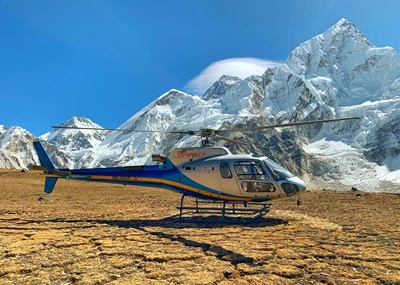
We offer you the exceptional opportunity to transform your journey between Lukla and Kathmandu with our exciting and exclusive helicopter charter flights.
Helicopters have always been one of the most thrilling, safest, and most luxurious modes of transportation. Imagine, sitting inside a small cabin with few travelers, with headphones on your head watching through the large glass windows below the sky.
It is also one of the secure travel options that very little depends on the weather and offers you more flexibility and an intimate experience. If you also wish to have a remarkable experience, then we can arrange for the charter heli flight for you between Kathmandu and Lukla: one way or the round trip.
You just need to inform us beforehand so we can turn your simple journey into something extraordinary.
When you arrive at Tribhuvan International Airport, we will arrange for your transfer to the hotel. An expert guide will thoroughly go over the day’s tour schedule with you as you check in, making sure you are ready for the exciting day ahead. You will have a breathtaking road trip from Kathmandu to Bhandar via Jiri the next morning. Your trekking journey begins at this point. You will trek through the lovely villages of Sete, Junbesi, Nuntala, Khari Khola, and Puiyan for several hours each day.
After arriving in Puiyan, you will continue on to Phakding, where you will join the official Everest Base Camp Trek. There are some amazing views from the high-suspension bridges along the way from Phakding to Namche Bazaar. One of the area’s lovely settlements is Namche Bazaar, which will provide hikers with a comfortable day off. A climb to the Everest View Hotel from here offers stunning views of the Ama Dablam, Thamserku, Namche, and Mount Everest, among other ranges.
The following day’s trial will lead you via the villages of Gokyo, Machherma, Dole, and Phortse. This portion of the journey also includes the second acclimatization day, during which the hikers ascend 5357 meters in a 6-hour arduous climb. There are breathtaking views of the Himalayas as you climb over Gokyo Ri, Thangna, Cho La Pass (5420m), Dzongla, Lobuche, and finally reach Everest Base Camp. You will spend the night at Gorakshep following your tour to the base camp.
Set at 5,550 meters above sea level, Kala Patthar may be the best place to see Mount Everest. After Pheriche, Namche, and Lukla, where you catch a flight back to Kathmandu, the trail drops. After that, you will be taken to your hotel in Kathmandu, where you can spend the remainder of your day relaxing or shopping. The next day will mark the conclusion of your exciting adventure, after which you will be driven to the airport to begin your flight home.
The best seasons for trekking in the Everest region are spring and autumn. Autumn begins in September and lasts until November, while spring begins in March and lasts until May. This is the perfect time of year to completely enjoy the expansive vistas of the mountains because of the pleasant weather and clear sky.
After a frigid winter, spring brings pleasant weather. The rhododendrons will be in flower, and the skies will be clear, making the trails lovely during this time. Similarly, you experience breezy weather during the autumn, which makes your hike even more enjoyable.
It is possible to trek in the summer/monsoon and winter seasons. But it has drawbacks. Hikers will encounter significant snowfall on the trails throughout the winter months of December through February. However, the monsoon season is also not the best time of year to go trekking. Due to high clouds and rain, visibility may be poor and the trails may be muddy and hazardous. Additionally, there will be a lot of airline cancellations and delays around these times.
The Everest region, altitude sickness is a serious issue. At Kala Patthar, you will hike as high as 5545 meters. Although the likelihood of altitude sickness is great, you should not be concerned.
Our trekking guides are highly skilled experts with extensive training. First-aid kits including all the necessary drugs for high-altitude illness will be on board. Therefore, even though the walk is difficult, we will assist you in finishing it.
We have alternative trekking programs that will pique your interest if you are still not happy with the EBC Classic Trek. The following is a list of these packages:
We would like to recommend the normal 16-Day Everest Base Camp Trek for people with limited time. In addition to the trip from Kathmandu to Jiri, you will hike from Kathmandu to Lukla.
In addition, there is the Everest Base Camp Short Trek, which is a 14-day journey. It travels the same path as the shipment mentioned earlier.
We have now reached the conclusion of the overview. We hope reading about this trek’s intriguing highlights was enjoyable. You can get in touch with us and submit an inquiry if you would like additional information about this expedition.
A comfortable three-star hotel will be your place to stay when in Kathmandu for three nights. A double-person room with two single beds, an attached toilet with a hot shower 24 hours, and WiFi will be offered to you as the amenity of the hotel.
During the hiking part in the villages, the cozy mountain shelters called the tea houses will be your resting haven after a day of hike. These shelters are sometimes modest with sharing facilities of the latrines and dining room. For more privacy, we also offer upgrade options which you can check out on our add-on options.
As for the dining arrangements in Kathmandu, your each morning will start with a hearty breakfast in your host hotel. Lunches and dinners will be in your chosen restaurants on your own.
When walking, full three times meals (lunches, breakfasts, and dinners) will be served at the host lodges. Dal Vat and momos will be the common items on the menu along with some European varieties of pizza, pie, noodles, etc.
All airport transfer-in and transfer-out between TIA and your hotel will be conducted in a private vehicle (car, bus, jeep, or van). We will also be looking after the arrangement of internal flights between Kathmandu and Lukla.
Private transport will be utilized in case of a need to reroute to Ramechhap for the flight to Lukla.
With the following permits, you will be able to successfully achieve this EBC with Gokyo Lake 21-day trek journey as they are specified:
Sagarmatha National Park Entry Permit: This permit is essential to move into the Khumbu area, which is a part of the National Park of the place. Without it, there is a strict ban you have to adhere to if you try to enter Monjo gate while hiking to Everest base camp.
Khumbu Pasang Lhamu Rural Municipality Permit: Similarly, you will also need this local permit to enter the Khumbu region. By the way, it is beneficial for the local community to enhance their life. On your arrival to the Everest region, you will not just have a trek, but also there will be several positive aspects that come to the region via your travel.
TIMS (Trekkers’ Information Management System) Card: In Kathmandu, the capital city of Nepal, you can easily obtain this permit from the Nepal Tourism Board. This permit helps to keep records of the visitors and provides immediate aid in times of emergency. Everest Summit Treks will take care of your permits before you arrive in Nepal if you provide all your required papers for documentation and obtaining these three permits. We focus on your comfort and stress-free journey.
Our EBC with Gokyo Lake 21-day trek does not include travel insurance in Nepal. You need to purchase it yourself. If you don’t know good travel insurance companies, our tour company, Everest Summit Treks, will also help you select the right option that covers all the required risks and needs while traveling.
You are required to have travel insurance compulsorily. Your insurance will cover your extra possible expenses, such as accidents, injuries, treatment, medical expenses, emergency helicopter rescue, theft, damages, etc., that can ruin your trekking experience completely. This travel insurance will enhance your trekking experience without making you worry about potential unexpected additional expenses.
Everest Summit Treks and Expedition is known for organizing treks with experienced leaders and personnel who take care of all your travel requirements. In addition to being a certified sustainable travel agency, we support the notion of giving back to the community by taking part in a number of charitable endeavors.
In the event of travel cancellations or delays, it is wise to factor in an extra day or two before and after the days you want to trek. Additionally, it allows you to purchase the necessary clothing, equipment, and other things in advance of your journey.
Please note that any difficulties or missed foreign flights brought on by unanticipated circumstances, such as airport changes, aircraft delays or cancellations, etc., are not Everest Summit Treks & Expedition’s responsibility.
Our guides are fluent in English, yes. Before becoming trekking guides, the majority of them work for three to four years as porters. Their proficiency in English is derived from practical experience rather than formal schooling. Please be aware that although they can communicate well, their fluency may not be as high as that of native speakers because English is not their first language. Additionally, they will help with communication, particularly when many locals, such as teahouse hosts and shopkeepers, may not speak English.
Autumn (mid-September to November) and spring (March to early June) are the ideal times of year to trek the Everest Base Camp Trek. We can plan this excursion to fit your schedule, and it is doable all year round.
However, we usually advise avoiding the rainfall season (July and August) and doing this walk during the good seasons. The temperature in the mountains can be a little harsh during the chilly months of January and February. However, since it is less busy and you are well-prepared with the right winter clothing and other equipment, some people prefer to go during these months.
Outside the airport terminal, our crew will be waiting for you with our sign that reads “Everest Summit Treks and Expedition.” A private tourist van will drive you to a hotel.
The elevation and length of the Classical Everest Base Camp Trek make it a little difficult. It is a demanding journey that requires five to eight hours of walking each day.
The maximum weight for the Lukla flight, including your daypack and duffel bag, is 15 kg (33 pounds). You can pay an additional USD 2 to USD 5 per kilogram if your daypack weighs more than the permitted amount. Sometimes the baggage allowance is withheld even though the pay is higher. As a result, we advise you to pack no more than 15 kilograms.
Vegetarian meals are served at the majority of mountain teahouses. Therefore, vegetarianism is not an issue. It is better to eat vegetarian food to prevent indigestion and food poisoning.
yes hot showers are offered from Lukla all the way to Namche Bazaar. There may be showers available in certain settlements at higher elevations as well. At higher elevations, however, you can buy a pail of warm water to use for bathing. Showering above the settlement of Dingboche is not advised in order to prevent illness. Each shower during the tour will cost an extra $5 to $8, depending on the location.
Our guides are accessible for assistance around-the-clock. They know how to use an oxygen meter and have received training on how to use a first aid kit. They are well aware that oxygen levels decrease with altitude, thus they want to know our client’s oxygen level and whether they are healthy enough to continue or require additional safety measures.
To keep track of each client’s location and status, guides carry local SIM cards from Nepal Telecom and Ncell. In an emergency, our guides are on guard and stay in touch with the head office in Kathmandu, which is open around-the-clock to make arrangements for everything from horses to mules or helicopters, particularly when a customer is extremely ill in the mountains and needs to be taken to the hospital.
Yes. Higher elevation guesthouses like Lobuche and Gorak Shep charge extra for oxygen if necessary. Since oxygen can be expensive, we advise getting travel insurance so that you can get your money back.
For an additional $200 USD, we can additionally arrange for pre-booked oxygen for one tank, which you may carry with you on your hike from Namche to higher altitudes.
Yes, you need to reserve your flights abroad. Since we are a local company, we do not book flights abroad. On airline websites, you can quickly peruse flight tickets to reserve the one that best suits your needs.
